
[Page 1]
10,000 Tampa Avenue
Chatsworth, California
November 3, 1946
Dear Rose Wilder Lane:
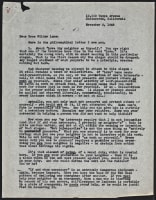
Here is the philosophical letter I owe you.
1. About “Love thy neighbor as thyself.” You are right that one of the troubles here lies in the word “love.” It’s certainly the wrong word, with no exact meaning in this particular slogan. That is the first reason why the slogan should be dropped. Any inexact statement of what purports to be a principle, creates nothing but harm.
But whatever meaning we attempt to attach to this slogan—it still remains a tenet of collectivism. If “love” here means self-preservation, as you say, or the protection of one’s interests—well, it still means that you must preserve and protect others as much as yourself. Since your chief activity of self-preservation on earth is work to obtain food, the slogan means that you must work for others just as much as for yourself. If so—collectivism is the proper social system for men. (A slogan or precept should be applied and observed literally, concretely, consistently, in every instance which it covers—or not at all.)
Actually, you not only must not preserve and protect others as yourself—you could not do it, if you attempted to. Each man’s fate is essentially his own. Any help you can give him is strictly of a secondary nature. Example: any poor relative. Have you ever succeeded in helping a person who did not want to help himself?
Now when you say “my interests require that I do not jeopardize (and that if and when necessary, I protect) my neighbor’s”—this is quite another matter, and not at all within the meaning or intention of that slogan. “Not to jeopardize” is not the same thing as “actively to preserve.” What you owe yourself is to work for your living; what you owe your neighbor is not to interfere with his work. This is not loving (or preserving) “as much as yourself.” Every moral duty you owe to yourself requires a positive action; everything you owe your neighbor is negative—to abstain from action that would infringe his rights.
It’s that element of owing, of a moral duty, which is crucial here. If you owe your protection to your neighbor—then it is a claim which he can and must present against you, should you fail in your duty. And who would define the debt and the failure? You or he?
“If and when necessary” is an extremely dangerous statement—again, because inexact. Here you have the base of the New Deal pattern of declaring one emergency after another. If you must help your neighbor in an emergency, then a man who is starving by reason of his own errors, shiftlessness or laziness is certainly in a state of emergency, he needs your help, so he would be justified in demanding it.
[Page 2]
2.
Now I say, you owe nothing to your neighbor. If you want to help him—that is another matter. Then the determining factor is your desire—not his need. It is then a favor to him—not his rightful due.
Now, must you always want to help him? Is it morally desirable that you should? No. Here is where the real issue comes in: you may (morally) wish to help him only when such help does not involve the sacrifice of your own interests. Example: you may loan money to a friend in need, if you really like him and can spare the money; but if you give him money which you need yourself for a major purpose of your own—I say you are positively immoral. More specifically: if your friend needs money for food, and you pass up buying a new dress and give him the money—that is all right. But that is not a sacrifice, because you actually wanted him to have food more than you wanted a new dress. But if that money was required to finance your education, or career, or wedding, or even if you wanted that dress for a date with your sweetheart—then you would be immoral if you gave that money away. You cannot place the interests of another man above yours, nor on an equal basis with yours. Yours must come first. (Always remembering that his come first for him.) That’s the only way men can live together at all. Any conflict of interests must be solved by mutual voluntary agreement. Actually, there can be no essential conflict of interests among men, if none demands or expects that which is not his, if each man recognizes that none of the others exists for his sake and that he can demand nothing from them on the ground of his need.)
Take your own example—about rushing to put out the fire in a neighbor’s house. You may (and would) certainly do that—if your own house is not on fire at the same time. But if it is? Whose house would you and should you save first? Of course your own, and properly so. Therefore, you cannot “love him as you love yourself.”
(And, incidentally, I would object to the sentence in your letter: “Therefore you will love your neighbor’s house as yours, at least until the fire is out.” That is really using words much too loosely. You wouldn’t love the house at all. At best, you’d feel sorry for the neighbor—but you’d feel nothing whatever for his house as such—whereas you actually do love your own house.)
Now of course I don’t believe that there is any “natural” or instinctive human action. (I won’t try to state my reasons here—that would have to be a treatise on the nature of man.) Human actions proceed from intellectual premises, accepted consciously as convictions or on faith, as axioms. So I don’t think that you run to save your neighbor’s house by reason of a natural impulse. You do so by reason of the premises you have accepted about human relations in general—and one of them is benevolence toward other men, which is natural in the sense that there are good rational grounds for it—unless the particular man has forfeited this benevolence. Would you always rush to save that house? I am sure that if it were the house of, say, Henry
[Page 3]
3.
Wallace—I would not rush to save it.
And this leads me to my main point about human relations: man being a creature of free will, any blanket commandment about what one should feel toward him is completely improper. Feeling proceeds from judgment based on a code of values. Man must be judged by his own record and actions—which may be anything. You love or hate him accordingly. A blanket command to love is collectivism. Love (or any feeling toward another person) is and can only be individual, with an individual object, for the individual reasons of each particular case.
Personal note: Love is such a tremendous thing that it makes me twist with anger (almost “instinctively,” only I know that it isn’t an instinct) whenever I hear it said that I must love my neighbors or men in general. Love is such a great, magnificent exception which one grants only to such great qualities (to me, love is what I feel for Howard Roark) that it makes me sick to think I am expected to feel it for Hitler, Stalin or the village idiot. Yet, they’re men, aren’t they? No, I’ll never agree to love men, collectively, indiscriminately, just for being men. I love Roark too much.
Incidentally, you say that you “don’t exactly love” yourself. I know this will sound strange, but I do love myself. Though I grant you it’s a somewhat different kind of feeling than the one I feel for other people whom I love.
2. Now, next point. You ask, “Isn’t there a vital distinction between co-operation and collectivism?” There is—and how! And it lies precisely in not having to love your neighbor as yourself. When you deal with men on a basis that involves no self-sacrifice—when you make contracts, or agreements, or hire people, or take a job, only as your personal interests may require—only then can you have true co-operation. Collectivism requires self-sacrifice, the subordination of one’s interests to those of others.
You are right, of course, when you say that collectivism disintegrates human cooperation and comes to “dog eat dog.” Only free, independent men can co-operate and feel benevolence toward one another. But they can do it only because (and only so long as) they know that co-operation will involve no pain or injury to them—that is, no demand for self-sacrifice.
But co-operation cannot be placed first, in the sense of saying that we must co-operate with others—if by co-operation you mean acting in a common enterprise. There are instances when we wish to act together with others—and instances when we prefer to act alone. Here again, how would you apply it concretely, if you preached co-operation as a general rule of conduct, as a conscious policy to be adopted by every man? If the community in which I live needs me and wants me to be a night watchman for them, and I want to be a writer—do I have to co-operate?
Co-operation is not and cannot be a conscious, deliberate
[Page 4]
4.
consideration, or a rule of conduct, or a set policy. It’s a consequence—call it a natural result, if you wish—of voluntary association among men, each acting in his own interest. The over-all result of each pursuing his own interest will be a society of peaceful, harmonious co-operation—such as a capitalist society. But it’s not done through any “will to co-operate”—only through pursuing one’s own interests, while respecting the same right in those with whom we deal.
Of course, Individualism doesn’t mean isolation, aloofness or escaping to a desert island. In fact, only true Individualists are fit to associate with other men. But they do it only on the basis of the recognition of each man’s essential independence: each man lives primarily for, by and through himself, and recognizes the same right in others; all relations among men are secondary; men are legally and morally free to associate together or not, on any particular occasion, as their personal interests dictate. There is the pattern of a free, moral society, of human co-operation, and of benevolence among men.
3. Now, about self-sufficiency. It is true that if I were born alone, in pre-civilization days, I would not have radios or typewriters. But all the wonderful things around me now, which are the products of civilization, are not mine and are not available to me—unless I produce, by my own effort, some material equivalent which I can exchange for the radios, typewriters or any other object I may want. If I don’t produce it, I can’t have it. Neither morally, nor in fact—I have no right to demand it and nobody is going to produce any material objects for me.
Each man actually produces only that which he produces—and no more. Yet we do see that the total material wealth of mankind grows greater, as civilization advances, and the average material wealth grows greater. Why is that? The personal qualities or abilities of men in general are not improving, not growing greater—and in some periods, like now, they are actually deteriorating. Then where does that extra wealth and production come from?
There is only one great debt that men owe to others—and it’s not a material one (though its results are material). The only real benefit we receive from others is the benefit of the accumulated thinking of the men who preceeded us, or of our own contemporaries who have superior intelligence. If I were born alone on a desert island, I could work as hard as I do now, with the same ability—and I would not achieve a material return equivalent to the one I get now. It is the accumulated thought, knowledge and discoveries of the past that make my efforts produce more (materially) than if I were starting alone from scratch and had to spend my life inventing the wheel (if I were even able to invent it.) The fact that billions of human beings are working at something and producing something around me does not actually add to my material welfare. What they produce, they keep for
[Page 5]
5.
themselves—or, to be exact, they keep its material equivalent, in the process of exchange. The something extra I get from men, the thing that raises the material efficiency of my own efforts is not the anonymous hordes of the “common man.” It’s the thinking, the ingenuity of the exceptional men who discovered and showed me better ways of doing things, which I would not have discovered by myself. The great advantages of an exchange society—of a division of labor and specialization—were made possible only by these thinkers and discoverers. Now the degree to which I profit from this accumulated intelligence depends upon my own intellgience, upon my ability to understand great thinking, to grasp it and to apply it. If my ability is great—then to carry it forward. If my ability is of the lowest order—then I still get a benefit from the intelligence around me, only in this case almost totally underserved, completely “extra”.
No, the food in my cupboard and the typewriter I use do not come from the “less competent men,” who feed me while I write. They don’t feed me. I’ve paid them for it. It is only themselves that they feed. If I were alone, I’d grow my own food—and I would grow more than they would, if they were left alone. But what I haven’t paid—and can’t pay—is the man who invented the telephone or the typewriter. The material comfort which I now have and couldn’t have if left on my own—comes from him.
A good mechanic may earn his own living by his own honest effort. But a great part of the material return which his effort brings him is due to the engineering genius who designed the engine or the scientist who discovered the necessary knowledge—achievements which the mechanic could neither equal nor grasp. Now suppose the genius and the mechanic are each born alone in the jungle, separately, starting from scratch. The genius will discover fire. The mechanic will perish. It is in this sense that the best brains of mankind carry the rest. The geniuses do not need the mechanics in order to survive. The mechanics do need the geniuses. (There is no harm in this relationship, no literal parasitism—so long as men are left free to work as they will or can. The genius exchanges his material product with the lesser man in a fair and proper exchange. The only point is that the exchange is equal materially—but not spiritually. The lesser man gives the genius only a material product; the genius gives him a material product—plus the knowledge of a discovery that adds to his, the lesser man’s, effort. The genius could have produced what the lesser man gives him; the lesser man could not have produced what the genius gives him. This is quite all right—and the genius is not robbed in this process—so long as he is left free to function. But his part in this process must be recognized and acknowledged for what it is.)
But, you’ll say, what about the lesser jobs? Aren’t mechanics necessary in our industrial civilization or our mass production? And I will answer that without the mechanics, no mass production would be necessary. The geniuses would satisfy their own needs through a different form of production on a smaller scale and would receive for it materially as much as they do now (if not more).
[Page 6]
6.
I believe you are extremely wrong when you say: “I think that you have only to decide not to buy a can of salmon, or fail by your efforts to obtain money to buy it, and the welfare of every one of them will be adversely affected.” Here, I think, you have unwittingly accepted a collectivist view of economics. The canners of salmon do not actually produce a can intended for me—and I do not let them down if I fail to buy it. A capitalist exchange economy—in essence and principle, though not in form—is an economy of independent, self-sustaining production. The salmon canner produces for himself—in the same sense as if he were operating a self-sustaining farm. If I am there to offer him something he wants, he gives me a can of salmon in exchange. If I’m not—he doesn’t make that extra can, but spends his labor on something else.
This applies to any production for a free market. Any producer produces only as much as he can exchange profitably (or as near as he can gauge the market). This means: only as much as he can convert into products for his own use. If men fail to provide him with a market, if they have nothing to give him in exchange—he doesn’t continue producing for them; his effort goes into another endeavor. So whatever he owns is the result of his own production—though it may have gone through many stages of exchange—a material equivalent of the material wealth he has produced.
Would we all get more if all men on earth were free to work productively? In proportion to the actual count of added noses—no. But to the extent to which there would be chained geniuses released to function—ah, yes!
No man produces any extra material value for another man—except the man of superior intelligence and to the degree of that intelligence. Most men just carry their own weight. Some do not even do that. And some give an inestimable extra benefit—free—to all mankind: the thinkers, the new discoverers. (Free—because whatever material return they get, it is never an equivalent of what they give.) They can exist and survive anywhere, by their own effort—except in a collectivist society, under compulsion; in that case, they are first to perish. And that is the chief reason why a collectivist society perishes, why it cannot prosper, produce or even exist for long.
You ask, what happens to my supply of food if all the stevedores stop working? Why, nothing whatever—in a free society. I will have to pay a little more for stevedoring—and ten men will rush to take each vacated job. (It’s only in a controlled society—like now—that we are at the mercy of anyone and everyone.) What if nobody wants to do stevedoring? Then I—and the rest of society—adjust our productive labor accordingly. The decision of the stevedores (or of any other group or man) affects us only superficially and temporarily—not essentially. And that, precisely, is the essence and advantage of a free economy—that nobody depends on anybody. Any man is free to change his mind about his work—and the rest are free to count him out and adjust their own production accordingly, without any material loss to themselves (or, at worst, only with a temporary loss.)
[Page 7]
7.
I know that I am profoundly indebted to Aristotle, to Thomas Edison, to Henry Ford. But to the Malayans and Cambodians?—hell, no!
(Do you know what I’ve written to you here? It’s the theme of my next novel. This is only a brief, partial statement—the subject is extremely complex. If I haven’t stated it clearly enough—you’ll see me do better when I present it completely in the novel.)
(This is the kind of letter-writer I am—either silence for months, or a whole treatise. You’ll wish I hadn’t become regular in my correspondence. So I’d better stop now.)
Now to answer your last letter, which I received yesterday. Yes, of course you may quote me from the Vigil, any time you wish.
I think you have undoubtedly analyzed Leonard Read correctly—and that makes me feel very sad. But it’s true. I was surprised to hear that he has repeatedly ignored your advice and offers of help (though in view of the general course his activities have taken, I shouldn’t be surprised). But he has always spoken to me about you with the greatest enthusiasm and respect, and he quotes you very often. I suppose, as you say, he just doesn’t understand the nature of application of principles—and he may not even know when he has contradicted your advice or mine. Or does he know? Anyway, I shall not attempt to help him or “enlighten” him any more.
It was interesting for me to read that you find it difficult to understand people. So do I, and always have. Only I don’t believe they understand one another, either. Look at the world right now, or listen to any conversation. It’s all meaningless gibberish and double-talk. I don’t think that “to understand” means to them the same thing as it does to us. What their equivalent for it is, I can’t imagine. Somebody once told me that the most cruel thing one can do to people, is ask them: “What do you mean?”
Report from a faithful reader: Have bought “Mr. Adam” on your recommendation—and enjoyed it immensely. Have sent for “Labor Unions—or Freedom?”, but haven’t read it yet. Have subscribed to “Plain Talk.”
With my exhausted, “philosophical” regards,
Sincerely,

Copyright © 1985 – 2025 The Ayn Rand Institute (ARI). Reproduction of content and images in whole or in part is prohibited. All rights reserved. ARI is a 501(c)(3) nonprofit organization. Contributions to ARI in the United States are tax-exempt to the extent provided by law. Objectivist Conferences (OCON), Ayn Rand Conference (AynRandCon), ARU and the Ayn Rand Institute eStore are operated by ARI. Payments to OCON, AynRandCon, ARU or the Ayn Rand Institute eStore do not qualify as tax-deductible contributions to the Ayn Rand Institute. AYN RAND, AYN RAND INSTITUTE, ARI and the AYN RAND device are trademarks of the Ayn Rand Institute. All rights reserved.